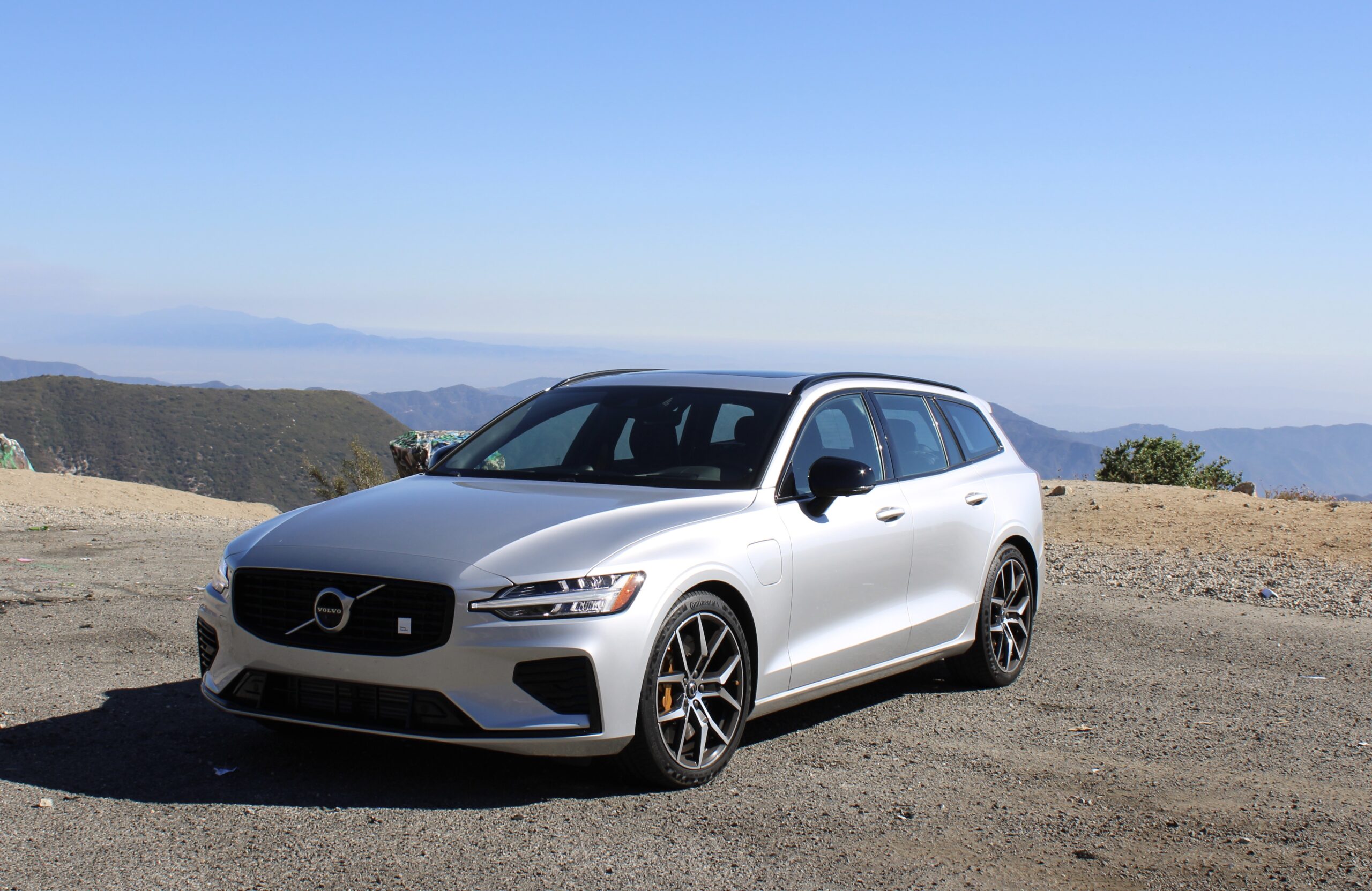
The Volvo sports wagon. An auto enthusiast’s biggest weakness, especially in brown and with a manual transmission. It’s the ultimate do-it-all vehicle. The car that checks every box (literally). Even though some brands also offer hot wagons, Volvo pioneered the formula with cars like the 240 Turbo and the 850 T5-R. It even raced the latter in the British Touring Car Championship. The V70R followed those two icons and is now highly sought after by collectors. However, one Volvo took the formula and made it nearly uncompromising: the plug-in hybrid V60 Polestar.
Volvo V60 Polestar: Electrifying Power, Scandinavian Style
Originally introduced as part of the first-generation V60, the Polestar model evolved into an electrified vehicle for its next iteration. Early models had a 2.0-liter turbo and supercharged four-cylinder coupled to two electric motors, an eight-speed automatic, and a high-capacity traction battery. These made 415 hp and 494 lb-ft of torque. Later versions dropped the supercharger and gained more powerful electric motors, as well as a higher-capacity battery. That increased output to 455 hp and 523 lb-ft of torque.
No matter which version you got, the V60 Polestar hauled ass. This compact wagon boasted considerable power thanks to its plug-in hybrid powertrain. Best of all, it had zero lag. You got unrelenting acceleration anytime you wanted it. The transmission shifted quickly and smoothly, adding to the effortless feel from behind the wheel. It worked best left to its own devices, though, because it didn’t respond that quickly to your inputs on the paddle shifters in manual mode. On the other hand, the standard Akebono brakes with their great pedal feel provided reassuring stopping that brought this car to a stop with authority.
In terms of efficiency, the V60 Polestar delivered, too. No surprise since it’s a plug-in hybrid. The EPA rated early iterations at 28/33/30 mpg city/highway/combined and had an all-electric driving range of 22 miles. Both figures were underrated. The car easily did 30 miles or more in EV mode, and in normal driving, it consistently managed over 30 mpg in mixed driving. 2023 to 2025 models nearly doubled the all-electric driving range to 40 miles, while the EPA ratings edged up slightly to 30/33/31 mpg. Once again, both numbers proved conservative.

Setting the Balance
A nicely tuned chassis rounded out the performance goodies, complete with manually adjustable Öhlins dampers. This gave the V60 Polestar excellent handling through the twisties, making it a joy to drive. Additionally, quick and accurate steering complemented the suspension, allowing you to feel even more connected to the road. It rode well, too. The sporty wagon does a great job absorbing all types of road imperfections, keeping things comfortable for the daily drive or road trips. However, we’d keep the dampers set to the middle setting because the stiffest setups noticeably degraded the ride quality.
Unlike non-electrified Volvo models, which use a mechanical AWD system, battery-electric and plug-in hybrid models like the V60 Polestar have an e-AWD setup. That meant its main electric drive motor powered the rear wheels. Additionally, the front and rear axles weren’t connected. This configuration added playfulness while maintaining its unrelenting grip across all weather conditions. As a result, the V60 allowed you to steer with the accelerator. The electric motor can overdrive the rear wheels, allowing it to rotate and minimizing understeer.
Timelessly Tasteful
It’s no surprise that the Volvo V60 Polestar still looks new even after its nearly 10-year run on the market. This is a proper luxury wagon, featuring numerous Scandinavian details, such as the Thor’s Hammer LED headlights and full-length taillights that frame the rear window. As a result of its tastefully restrained design, the V60 Polestar looks timeless. Meanwhile, touches like gold brake calipers, careful use of black trim, gold seatbelts, and model-specific 19-inch wheels added just the right amount of aggression to hint at its performance capabilities.
Inside, it’s textbook Volvo. Supremely comfortable and supportive front sport seats that you don’t want to get out of, excellent sound deadening, and generous cargo space with the rear seats up or down. Everything you touched felt expensive, from the metal speaker grilles to the plastics on the dash and door cards. However, keep it to two in the rear because that massive center hump effectively makes the center position useless. Additionally, the V60 lacked small-item storage due to the battery’s positioning in the center, where the driveshaft would be.
Since the V60 has the traditional wagon shape, it’s surprisingly practical for a compact car. It had plenty of cargo space with the rear seats up or down. Plus, you can stack luggage thanks to its boxy shape. Most importantly, it had a flat load floor, adding to its versatility.


Advanced Yet Simple
The V60’s tech features kept things easy, but it wasn’t until Volvo added Google Built-In later in the car’s life cycle. Early on, the nine-inch portrait-style touchscreen used Volvo’s in-house Sensus interface, which worked fine but was slow to boot up. It had Apple CarPlay and Android Auto, which worked well. Google UI made things much easier. However, both systems had endless submenus, making it hard to find the settings you wanted to change.
On the other hand, the 15-speaker Bowers & Wilkins premium audio system rocks. Clear, immersive, and downright epic, this remains the benchmark. Yes, it’s even better than the Naim audio system used in Bentleys. All 60 and 90 series offer a Bowers & Wilkins option in the highest trim, while Polestar Engineered models include it standard. If you can swing it, get it because it’s THAT GOOD.
As for driver assistance tech, Volvo has one of the better ones. The suite found in the V60 Polestar worked well and never got intrusive. Pilot Assist, a semi-autonomous driver assistance system, operated naturally and never got overly nanny-like. Most importantly, it kept the driver in control and never attempted to take over. In newer Volvo and Polestar models, Pilot Assist is even better and way smoother than older versions.
Volvo V60 Polestar: One Car To Do It All
There’s no denying that the V60 Polestar did it all. It’s fun, fast, practical, stylish…the list goes on. No, it’s not perfect, but it’s the closest car to ever define that word. Although other hot wagons existed, none ever managed to hit that Goldilocks sweet spot the way the V60 Polestar did. This car was Volvo at its best, all wrapped in the body style synonymous with the brand. Performance defined by Scandinavian sensibilities, timeless design, and electrified power, a match made in automotive heaven.
Unfortunately, Volvo recently discontinued the T8 Polestar model after nearly 10 years in production. That leaves the Cross Country as the only V60 available in the United States. If you’ve got a V60 Polestar as a lease or a vehicle you bought outright, keep it and treat it well. It’s a gem of a vehicle, one that never got the love it deserved.


One thought on “Volvo V60 Polestar Flashback Drive: THE One Car Solution”
Comments are closed.