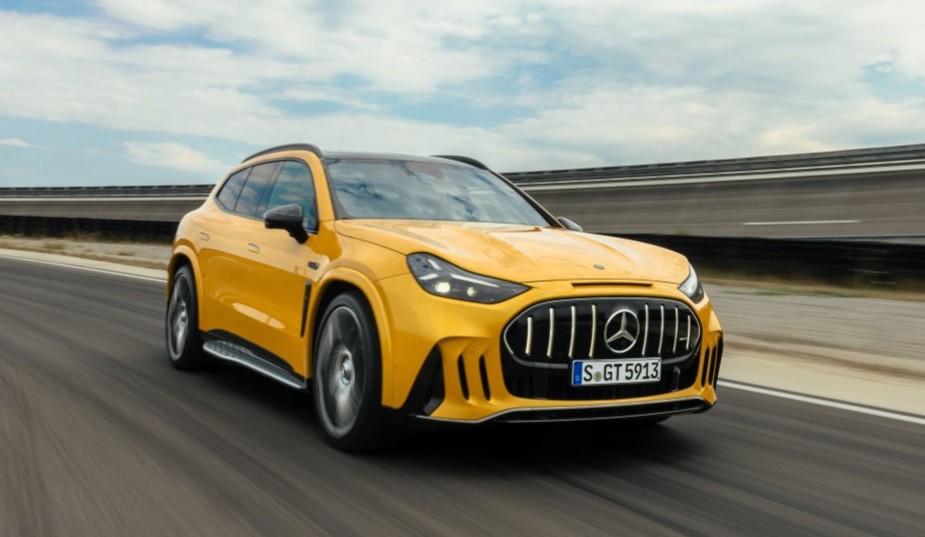
The Mercedes-AMG GT SUV may have the SUV acronym in its name, but it’s clearly not an SUV. Developed as AMG’s first in-house vehicle, this is a supercar in a more practical shape. Think slightly lifted all-electric super wagon. Like its four-door coupe sibling, the GT SUV features an aggressive, brutalistic design, complete with fancy lighting in the faux grille. The three-pointed star motif continues throughout the car, especially in the LED lighting accents. From the side, this super SUV features an upright greenhouse that highlights its more practical side. Meanwhile, the rear end follows the same design ethos as the sedan, complete with three-pointed stars embedded in the taillights.
All of that aggression goes beyond looks. The Mercedes-AMG GT SUV features plenty of functional details to help it go faster. These include the Aerokinetics roof spoiler on the GT 55 and GT 63, which automatically adjusts its position to reduce aerodynamic drag or increase stability. Meanwhile, the Aerokinetics Airpanel actively controls airflow via slats in the front bumper. These remain closed to minimize aerodynamic drag and only open when additional cooling is required.
Mercedes-AMG GT SUV: Driver-Centric and Tech-Packed
Step inside and it’s clear that the GT SUV is a driver’s car. Low-slung seats and a dash with a center stack angled towards the driver highlight its sporting mission. It features a standard 10.2-inch digital cluster, a 14-inch main touchscreen, and an optional 14-inch passenger display. You can also add AMG Performance seats, the Sky Control panoramic glass roof, and more. Mercedes-AMG also added controls for the AMG Race Engineer and AMG Drive Unit on the dash and/or center console. This allows for easy customization of the car’s driving characteristics. Want even more customization? The Manufaktur program has 60 exclusive exterior colors, as well as unique wheels and interior options.
Under all of that driver-centric luxury is Mercedes’ MB.OS, which integrates and controls all vehicle functions. Meanwhile, the latest MBUX interface handles infotainment duties and features artificial intelligence. The MBUX virtual assistant integrates ChatGPT, Google Gemini, and Microsoft Bing into one system. Like in other Mercedes vehicles, MBUX features a zero-layer setup, displaying the most relevant information, suggestions, and recently used apps front and center. Meanwhile, audiophiles can choose the optional Burmester 4D surround sound system, which features stainless steel speaker grilles.

Mercedes-AMG GT SUV: Electrifyingly Potent
At launch, the AMG GT SUV arrives in three versions. The GT 53 starts things off with a 106-kWh battery and a dual-motor setup, making up to 536 and 590 lb-ft of torque. Moving up to the GT 55 turns the wick up with three axial flux electric motors for a total output of 805 hp and 1,372 lb-ft. Want even more? The GT 63 has a massive 1,153 hp and 1,475 lb-ft, allowing it to hit 60 mph in 2.4 seconds on the way to an electronically limited top speed of 168 mph. Additionally, both the GT55 and GT 63 use a larger 128-kWh battery.
All GT SUV models use an 800-volt electrical architecture, allowing for insanely quick DC charging speeds. The GT 53 has a peak rate of 600 kW, while the GT 55 and GT 63 top out at 710 kW. Under ideal conditions, the AMG GT SUV can DC charge from 10 to 80% in 12 minutes when using a high-powered charger. On the more lenient WLTP cycle, the GT53 is rated at up to 415 miles per charge. Meanwhile, the GT55 and GT63 are WLTP-rated at up to 373 miles.
Not a One-Trick Pony
To complement all of that power, the GT SUV comes with high-tech chassis components. These include rear axle steering and, on the GT 55 and GT 63, the AMG Active Ride Control+ adaptive air suspension. The latter can raise or lower the vehicle as needed based on the speed and driving conditions. High-performance brakes come standard, with carbon ceramics available on the GT 55 and standard on the GT 63. AWD also comes standard, allowing for maximum torque distribution variability between the front and rear axles. Additionally, the AMG GT 55 and GT 63 SUVs have targeted torque vectoring, allowing for variable distribution between the rear wheels.
Extensive customizability plays a key role in the AMG GT SUV driving experience. As a result, it features seven drive modes, including AMGFORCE Sport+, which emulates an AMG V8 or I-6 engine depending on the model, and adds simulated gear shifting. Drivers can further customize the sound profiles based on their taste with additional sound options.
AMG also includes the Performance Menu, which shows crucial vehicle performance data in real time. On the other hand, AMG Track Pace allows the driver to record over 80 vehicle-specific data points 10 times per second. It can also work with the optional dash cam to record track sessions to overlay with the lap times and vehicle data. Want to further optimize the GT SUV on track? That’s what the Predictive Performance Manager is for. This system can tailor the car for track use, increasing and reducing output as needed depending on the circuit’s section.
Production of the AMG GT SUV will take place at Mercedes’ Sindelfingen plant, specifically Hall 32, one of the most historic Mercedes-Benz Group manufacturing plants. All three variants arrive in North America in summer 2027. Yes, they’ll come standard with an NACS charging port.
Source: Mercedes-Benz