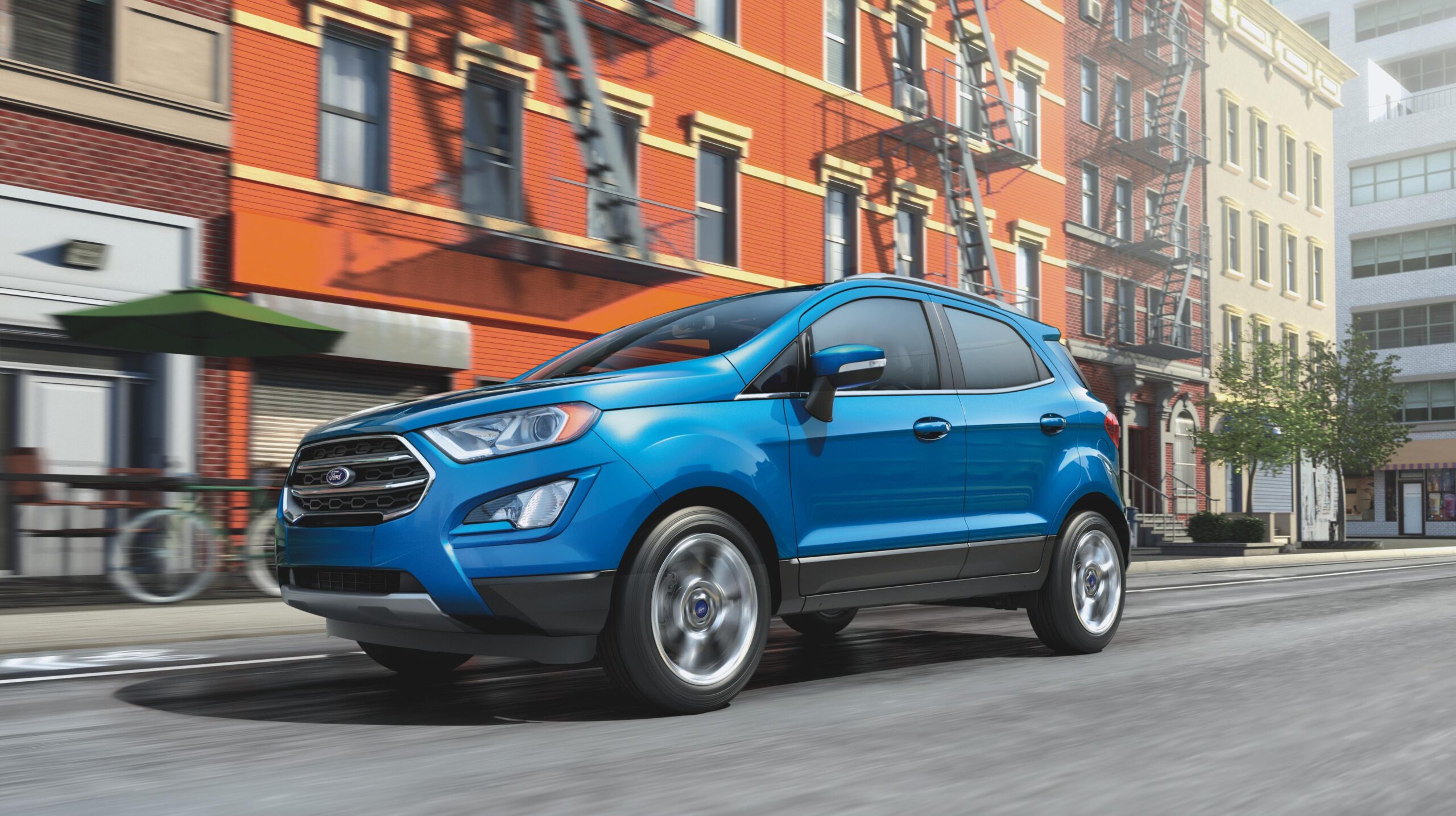
Subcompact SUVs became one of the fastest-growing classes in the late 2010s. Initially, cars like the Kia Soul and Subaru Crosstrek started the segment, and automakers entered it in droves, growing it to what it is today. However, that didn’t mean every entry was a strong one. Before the 2020s, so many subcompact SUVs failed to match the standard set by the two pioneering models. One of these, the Ford EcoSport, exemplified an automaker that simply rushed to phone things in. Take an Asian market vehicle built in India and sell it in highly demanding markets with different requirements.
By the time it arrived in North America for the 2018 model year, the EcoSport had been sold in other markets since 2012. As a result, it felt old even by the modern standards of that time. Despite its age, the tiny SUV still piqued my interest, so I lobbied hard to review it at MotorTrend. It worked. However, the moment I got on the road, I discovered a car in dire need of a redesign.

Ford EcoSport: Awkwardly Weird
The EcoSport’s proportions made it look odd…in a very bad way. Narrow, yet tall, this little guy was among the smallest vehicles in the subcompact SUV segment. It looked like a cartoon-y cute-ute in every sense, bubbly but far from cute. From the conventional front fascia with angled headlights to its squared-off profile and upright rear end, the EcoSport’s design didn’t flatter. Furthermore, it suffered from excessive road and wind noise due to its shape.
Furthermore, the tidy footprint resulted in a tight, narrow cabin. Front seat occupants had decent space, but those in the rear were cramped. The lack of head and legroom meant even shorter adults had limited space. Cargo space was at a premium, too. Yes, you had height, but length? Not much. Its swing-out rear door also cuts into the usable capacity that a traditional roof-hinged hatch wouldn’t do. Additionally, the fit and finish ranked among the worst. Although the EcoSport had soft or padded surfaces, nearly everything you touched inside felt cheap.
On the bright side, the EcoSport had user-friendly tech with Ford’s SYNC 3 interface on an eight-inch touchscreen. Thankfully, the system kept submenus minimal and was reasonably responsive to your inputs. It also included Apple CarPlay and Android Auto, as well as a B&O premium audio system with nine speakers that offered a crisp listening experience. However, it lacked a full suite of driver assistance technologies. The only one available? Blind spot monitor with rear cross-traffic alert.


An Underwhelming Drive
Things fell apart for the Ford EcoSport the moment you drove it. This was among the slowest subcompact SUVs I’ve ever driven, and yes, even slower than the first-generation Nissan Kicks. The front-drive model’s 1.0-liter turbo-three only made 123 hp and 125 lb-ft of torque, resulting in lethargic acceleration even from a rolling start. AWD models had a naturally aspirated 2.0-liter I-4 with 166 hp and 149 lb-ft, but weren’t much quicker because they’re over 300 pounds heavier. An uncooperative and poorly tuned six-speed automatic exacerbated this slowness even more.
It doesn’t get any better when you take turns. The upright profile and narrowness gave the EcoSport a top-heavy feel when taking turns. As a result, it had sloppy handling. To make things worse, the car didn’t ride well over broken pavement, followed grooves on the road, and had uncommunicative steering. To put it simply, this car fell short of the entire segment in terms of the driving experience.
The EcoSport’s unimpressive EPA MPG estimates made things even worse. FWD models had an EPA-estimated 27/29/28 mpg city/highway combined rating, while AWD models checked in at 23/28/25 mpg. Yup, they’re not efficient. That rang true in real-world driving, too, because we met these figures pretty easily. However, a caveat for the three-cylinder engine: it wants premium gas for full performance.
Forgotten For Good Reason
Between the time of its introduction and its discontinuation in 2022, Ford sold around 254,000 examples of the EcoSport. While that number seems like a lot, it’s not. Several competitors can move that amount of metal in one year. As a result, time forgot this SUV for good reason. It fell short in so many ways in a segment packed with strong entries. Think of the EcoSport as an incredibly poor band-aid solution. A car that was brought in to quickly answer a growing trend without taking the time to develop it for the target market.