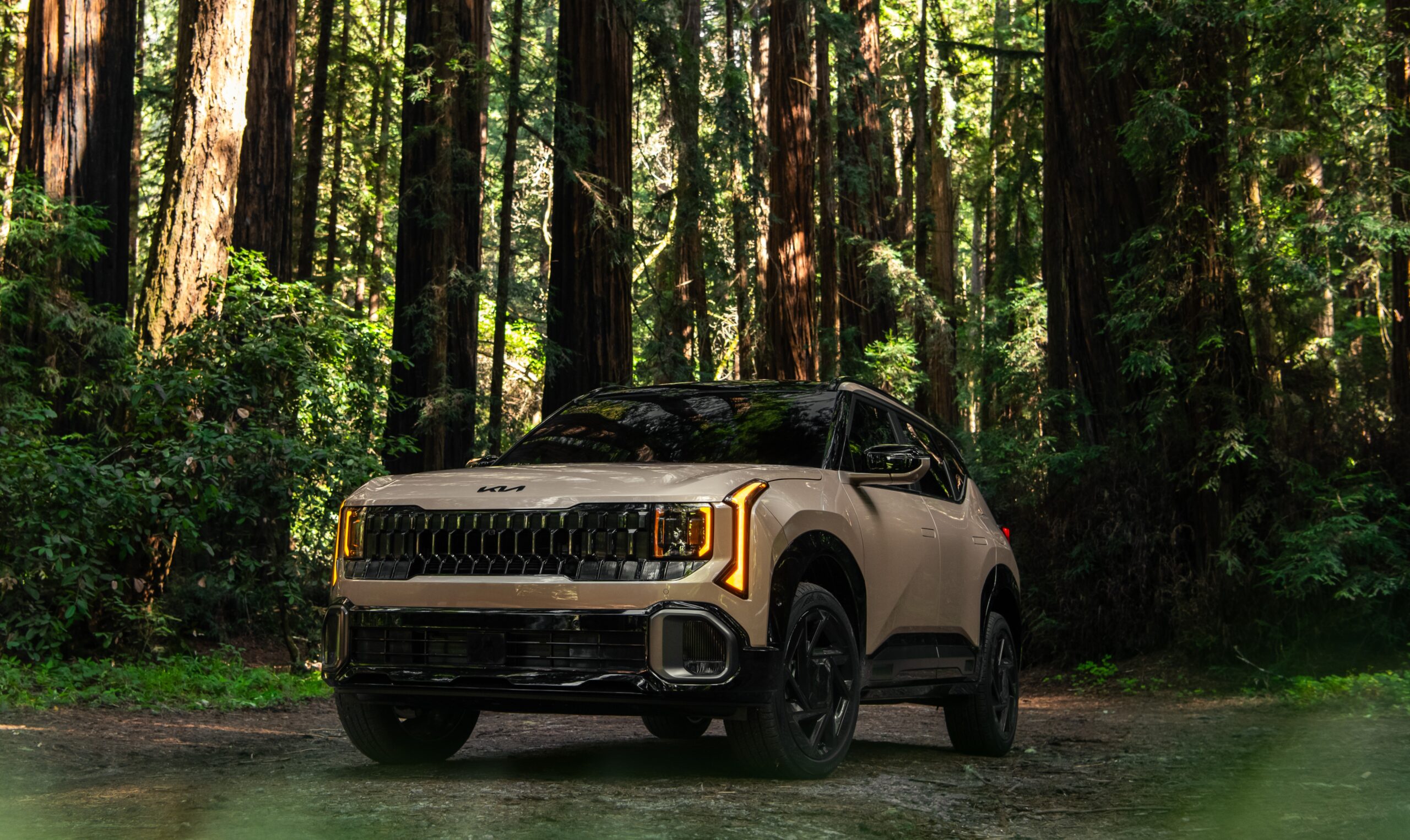
We finally know what Kia’s plans are for the mid- to long term. Like sister brands Hyundai and Genesis, it’s big. As in really big. The brand intends to invest a total of $33 billion over the next five years. Beyond autonomous driving and robotics, the big news here is the new vehicles. In total, Kia is launching over 30 new vehicles, including pure gas, hybrid, battery-electric, and extended range EV (EREV) models. Additionally, a next-generation EV architecture is already in the works.
So, what can we look forward to? A lot. On the hybrid and gas end of the spectrum, Kia began strengthening its offerings with the new Telluride and Seltos. Both offer gas and hybrid variants. The K4 hybrid is expected to follow these models. In 2030, Kia intends to expand its lineup with a body-on-frame pickup for core North American markets that offers both hybrid and EREV powertrains.
On the powertrain front, the Korean brand has improved efficiency by 4 percent with the introduction of its next-generation hybrid system earlier this year. It also plans to expand the availability of features like Stay Mode and vehicle-to-load (V2L) to more hybrid models. The Telluride Hybrid launched with these. In total, Kia aims to increase its global hybrid sales from 690,000 units annually in 2026 to 1.1 million by 2030. All while securing an additional 400,000 units of hybrid production capacity over the mid to long term.

Kia EV Lineup To Expand
As for its battery-electric offerings, Kia intends to add three new models, growing the lineup to 14 by 2030. These include two passenger vehicles, nine SUVs, and three purpose-built vehicles (PBVs). The company launched the EV2 and Syros EV this year. It will continue to introduce more high-volume EVs alongside a compact electric SUV while expanding its PBV offerings. A new EV platform is already in the works, featuring a 40 percent increase in battery capacity and a 9 percent improvement in motor output. The new EV platform also introduces fifth-generation batteries with 15 percent higher energy density.
Beyond new vehicles, Kia is prioritizing the expansion of charging infrastructure through strategic partnerships. This includes alliances with providers in key markets, such as Electrify America, IONNA, and Ionity. In Korea, it will help expand E-pit, Hyundai Motor Group’s DC charging brand. Additionally, Kia’s home market of Korea will serve as the global EV development and production hub for distribution to global markets. It intends to maximize production efficiency at its Gwangmyeong and Hwaseong plants to strengthen cost competitiveness for high-volume EVs. Additionally, Kia aims to localize its EV production strategy with regional demand and policy. This includes building the EV2 and EV4 in Europe, EV6 and EV9 in the U.S., and locally optimizing EVs for emerging markets like India.
Meanwhile, the Korean automaker aims to expand its PBV business and accelerate the global rollout of the PV5 to more markets. Two new models, the PV7 and PV9, will launch in 2027 and 2029, respectively. It aims to offer multiple configurations, including conversion models and B2B solutions to meet varying customer needs. Europe and Korea remain the key PBV markets.

Region-Based Growth
To achieve its target, Kia’s strategy focuses on tailoring its growth strategies based on the region. In the U.S., it aims to double its hybrid offerings to eight models and strengthen its SUV lineup. The company also intends to enter the pickup truck segment and introduce EREV models.
On the other hand, Kia’s European lineup will see an expanded EV lineup. It also aims to expand its hybrid offerings and PBV business in that region. In emerging markets, the Korean brand intends to expand its lineup to 10 vehicles, including various hybrid and EV models, and grow its dealer network to 800 locations. The key vehicles for growth in emerging markets remain the Seltos and Sonet.
Beyond new vehicles, Kia, along with the rest of Hyundai Motor Group, has partnered with major companies like NVIDIA. In addition to standardizing systems and sensors, the company will leverage data from mass-produced vehicles to continue the advancement of its proprietary end-to-end autonomous driving models. The first vehicle developed using this strategy arrives at the end of 2027. It features Hyundai Motor Group’s in-house software-defined vehicle architecture, the Pleos Connect infotainment platform, and Gleo AI, an in-vehicle agentic AI system.
Kia is also expanding in robotics, thanks to Hyundai Motor Group’s partnership with Boston Dynamics. It will create further synergies to help roll out new logistics innovations and move its software-defined factory initiative forward. Hyundai Motor Group Metaplant Georgia and Kia AutoLand Georgia will be among the first to use Atlas robots in 2028 and 2029, respectively.
Source: Kia

One thought on “Kia Announces Lineup Expansion of Over 30 Models!”
Comments are closed.