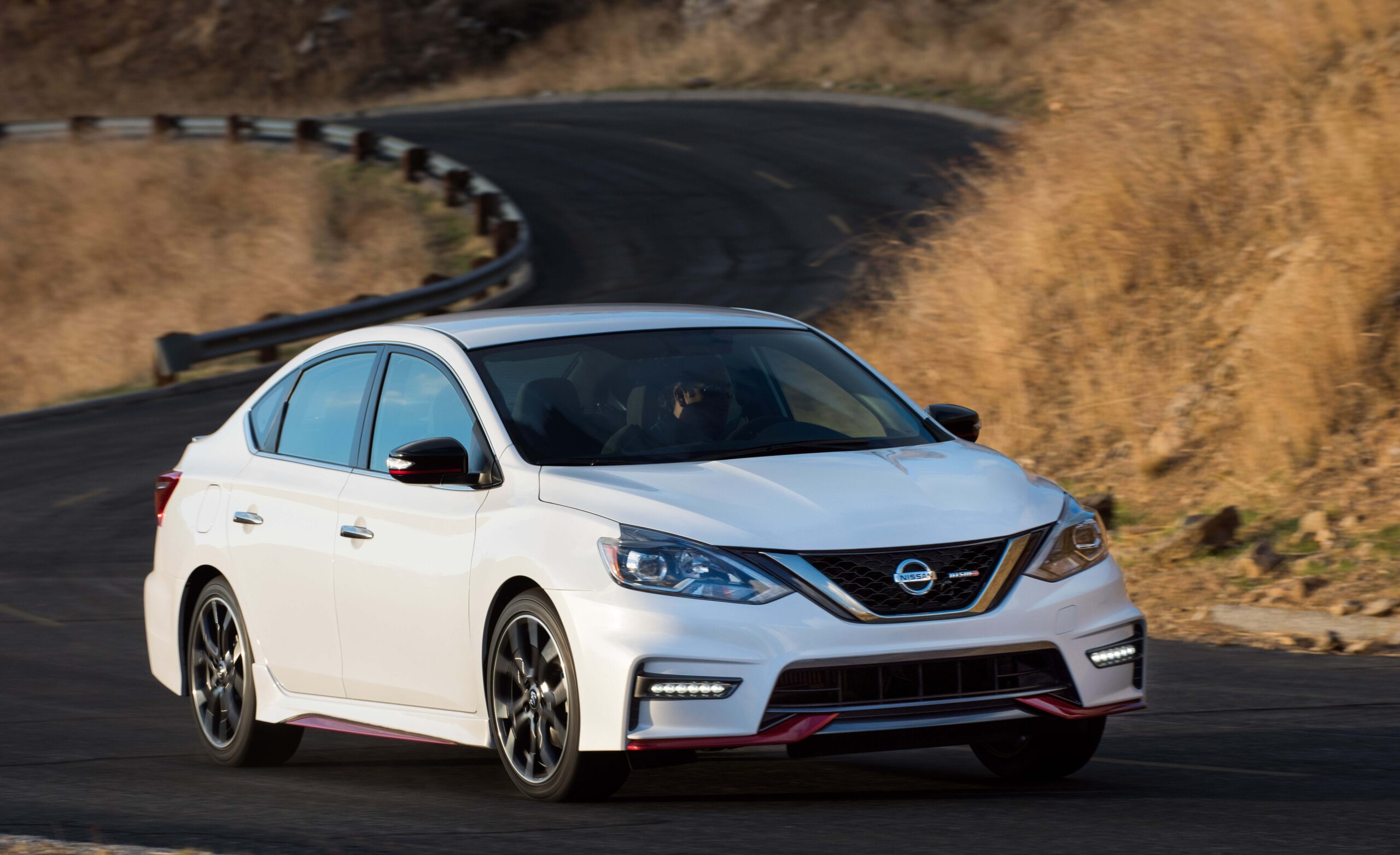
This performance sedan promised so much when it first debuted at the 2013 Los Angeles Auto Show. That was one year before I became an automotive journalist and started at MotorTrend. The production Nissan Sentra Nismo arrived three years later as part of the refreshed seventh-generation (B17) lineup that debuted as a 2013 model. It slotted above the SR Turbo, a higher-powered variant without any suspension tweaks. The Nismo variant took that up a smidge with several key changes, including a sportier suspension tune, stickier tires, lots of red accents, and distinct interior tweaks. However, these changes were not as extensive as what was originally promised by the concept.
Nissan Sentra Nismo: The Promise vs the Final Product
When it debuted as a concept in 2013, the Sentra Nismo brought plenty of attention to Nissan. Finally, the brand had an entry in the sport compact space once again! Nismo-tuned suspension and sticky tires with the looks to match, a 1.8-liter turbo-four with over 240 hp and 240 lb-ft of torque, and a six-speed manual. This show car promised a lot.
Fast forward to 2017, when the production Sentra Nismo debuted, and things weren’t exactly as promised. The lowered, performance-tuned suspension made it, but the tires? Not quite. Michelin Pilot Sport all-season performance tires replaced the summer rubber as standard equipment. Those became an optional extra. Its diameter also shrank from 225/35R19s to 215/45R18s. At least all of the styling details made it. Lots of red accents inside and out, distinct lower front and rear fascias, a rear spoiler, and cool 18-inch alloy wheels came standard. The Nismo Sentra also came with heavily bolstered front sport seats.
The big change from concept to production happened under the hood. Instead of the concept’s turbocharged 1.8-liter I-4, the production Sentra Nismo came with a 1.6-liter turbocharged four-cylinder engine, producing 188 hp and 177 lb-ft of torque. That’s the same as the SR Turbo and the base Juke. The latter’s Nismo model made 197 hp and 184 lb-ft from the same engine, but was downgraded for 2015 to match the Sentra. Meanwhile, the Juke Nismo RS bumped that further to 215 hp and 210 lb-ft with the manual or 211 hp and 184 lb-ft with the CVT. Like the Juke, the Sentra Nismo offered both a six-speed manual and a CVT. I only drove the former, and it’s the one I’d pick if you bought one used now, even with its flaws.

Not Quite Hot
Due to the modest output, the Sentra Nismo didn’t quite set things on fire. It had plenty of torque to play with, but not enough to cause trouble. As a result, torque steering wasn’t a thing, especially because the car had so much grip regardless of the tire you chose. Unfortunately, this little engine suffered from excessive turbo lag, making it feel a little more old-school. Below 3,000 rpm, there was next to no power. The engine woke up in its mid-range, but torque tapered off just past 5,000 rpm. You must keep this mill in its sweet spot to get the most out of it.
Having the six-speed manual helps with this because you can keep it in third or fourth gear and ride all of that torque. As far as the stick-shift operation goes, it… was not the best. Long, vague throws mean it didn’t like it when you rowed through gears quickly, resulting in somewhat jerky operation. Additionally, the clutch lacked a clear bite point, making it a chore in stop-and-go traffic. Furthermore, the excessive amount of rev hang made rev-matching downshifts a hassle, especially since the engine was so quiet and wasn’t so eager to rev.
On the other hand, the Nismo-tuned suspension provided great handling chops. Along with grippy factory tire options, the Sentra Nismo had no trouble tearing up a winding road. Good body control helped settle things, too. Sadly, the steering felt disconnected and wasn’t very communicative. Moreover, pushing the car hard caused it to default to understeer, especially around tight corners.
That handling came at the cost of compliance, though. The added stiffness meant the Sentra Nismo crashed over imperfect surfaces, resulting in a jarring ride. Additionally, the torsion beam rear suspension made the car feel jittery and jumpy over rough pavement.

Nissan Sentra Nismo: (Somewhat) Simple
Stepping inside, the Sentra Nismo immediately showed its roots. Yes, it came with supportive and heavily bolstered front sport seats and a roomy rear bench, but everything around them felt cheap. Hard plastics and the lack of sound deadening detracted from the overall feel. On the other hand, the tiny 5.8-inch touchscreen and gauge cluster display exacerbated that sensation. The former responded slowly and had dated graphics that looked like they came from the 1990s.
On the bright side, the rear seats had excellent space for three people across. Meanwhile, this generation of Sentra had a massive trunk, making it extremely practical for a compact sedan. The eight-speaker Bose premium audio system sounded decent, tooo. However, it got a little too heavy on the bass at higher volumes. Other than that, the Sentra Nismo didn’t come with many techn features. It came before the days of standardizing driver assistance suites, meaning no automatic emergency braking, blind spot monitor, and the like.
A Wasted Opportunity?
If you got the feeling that the Sentra Nismo disappointed me, you’re right. It did. The concept promised so much, but what arrived was nothing short of underwhelming. Yes, it handled well, but that came at the cost of ride comfort. Together with a laggy engine, a cheap interior, and a transmission that disliked enthusiastic shifting, the Sentra Nismo fell short of expectations. Putting it against key rivals like the Volkswagen Jetta GLI, Honda Civic Si, and Kia Forte GT further made this lack of competitiveness more apparent. This was a wasted opportunity, a car that had major potential that was never realized due to several factors.
Since then, the Sentra has put simplicity and value above all else. Yes, the last two generations now have independent rear suspension. No, it’s not the sportiest in the compact sedan segment. Will we see another Nismo model? I doubt it. But if we do, Nissan now has the right bones to work with. Now, put a proper powertrain on it and make it a proper sports sedan, not just some looks package with a crazy stiff suspension.