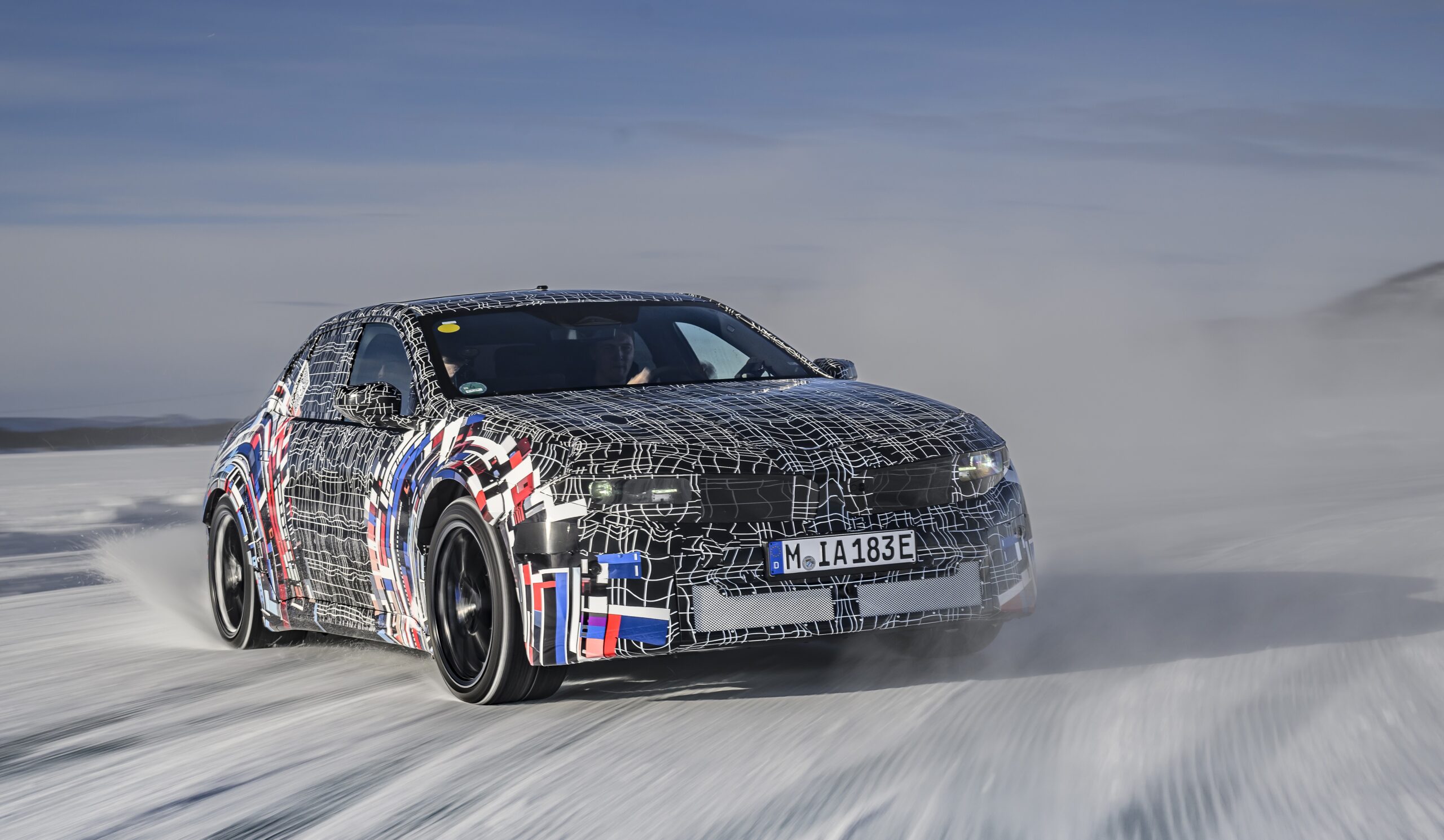
BMW M EVs are coming. Whether you like it or not, EVs are the future. Political issues merely delay the inevitable as the world eventually transitions slowly but surely. From 2027 onward, BMW will release its initial salvo of M-badged vehicles based on the Neue Klasse. The first of those core models, the iX3, debuted last year. Its sedan sibling, the i3, is expected to arrive sometime this year.
Franciscus van Meel, Managing Director of BMW M GmbH, declared that these next-generation models are poised to set a new benchmark among performance cars. They combine the legendary performance of a vehicle wearing an M badge with the advancements introduced by the Neue Klasse, including 800-volt technology. As a result, these high-performance EVs won’t sacrifice driving range, and they’ll work as daily drivers, too.
Moreover, they’ll use the brand’s new architecture paired with what it calls a “centrally controlled individual wheel drive” setup. This means a quad-motor layout, featuring one electric motor per wheel to elevate performance to new levels. They also work together with the four “Superbrains” to enhance the overall experience. Additionally, they can decouple the front motors, effectively turning the vehicle rear-wheel drive. Most importantly, it further improves driving dynamics while extending driving range and improving efficiency. When the driving situation requires more traction, the car simply reactivates the front motors.

BMW M EVs: Strong Foundations
The M Neue Klasse models feature motors based on the Gen6 units with high power density. However, they’ve been tuned specifically for duty in M cars, just like the Heart of Joy control software. Together, they promise to enhance performance cars. improving responsiveness, while optimizing traction and energy recuperation during regenerative braking.
On the other hand, the traction battery has 100 kWh of usable energy. BMW also adopted it specifically for use in high-performance vehicles while retaining its viability for road use. Featuring a cylindrical cell design, a cooling system, and an Energy Master, an intelligent control center optimized for high power output, supports the battery. As a result, it can charge faster and recuperate more energy via regenerative braking. Additionally, it serves as a structural component connected to the front and rear axles.
BMW also announced that it’s introducing natural fiber elements into its M vehicles for the first time. Originally used in motorsport applications back in 2019, these materials make their way into production high-performance EVs with the Neue Klasse. Most importantly, they produce 40 percent less carbon emissions during the production process. Expect the first Neue Klasse model wearing the coveted M badge to make its global debut later this year. We suspect both the i3 and iX3 will include them, with the former arriving first.
Source: BMW


One thought on “BMW M EVs Are Coming Whether You Like It Or Not”
Comments are closed.