Early last month, Volvo announced a 13-car product blitz, seven of which are meant for Europe and North America. While our attention went to the so-called “low cars” that are likely battery-electric versions of the S60 and V60, one model may just turn into an even bigger game-changer: the 2028 Volvo EX50 or project V326.
Slotting below the EX60, the 2028 EX50 replaces the EX30 and EX40 in North America. It’s also the first vehicle built at a new plant in Košice, Slovakia. According to prototype vehicle registrations reported by Swedish website Carup, the EX50 measures 4.51 meters, or 177.5 inches, long. That puts it in line with the Genesis GV60 and the Toyota C-HR/Subaru Uncharted. Versus the EX40, the EX50 will be 2.7 inches longer. Meanwhile, the EX30 is nearly a foot shorter.
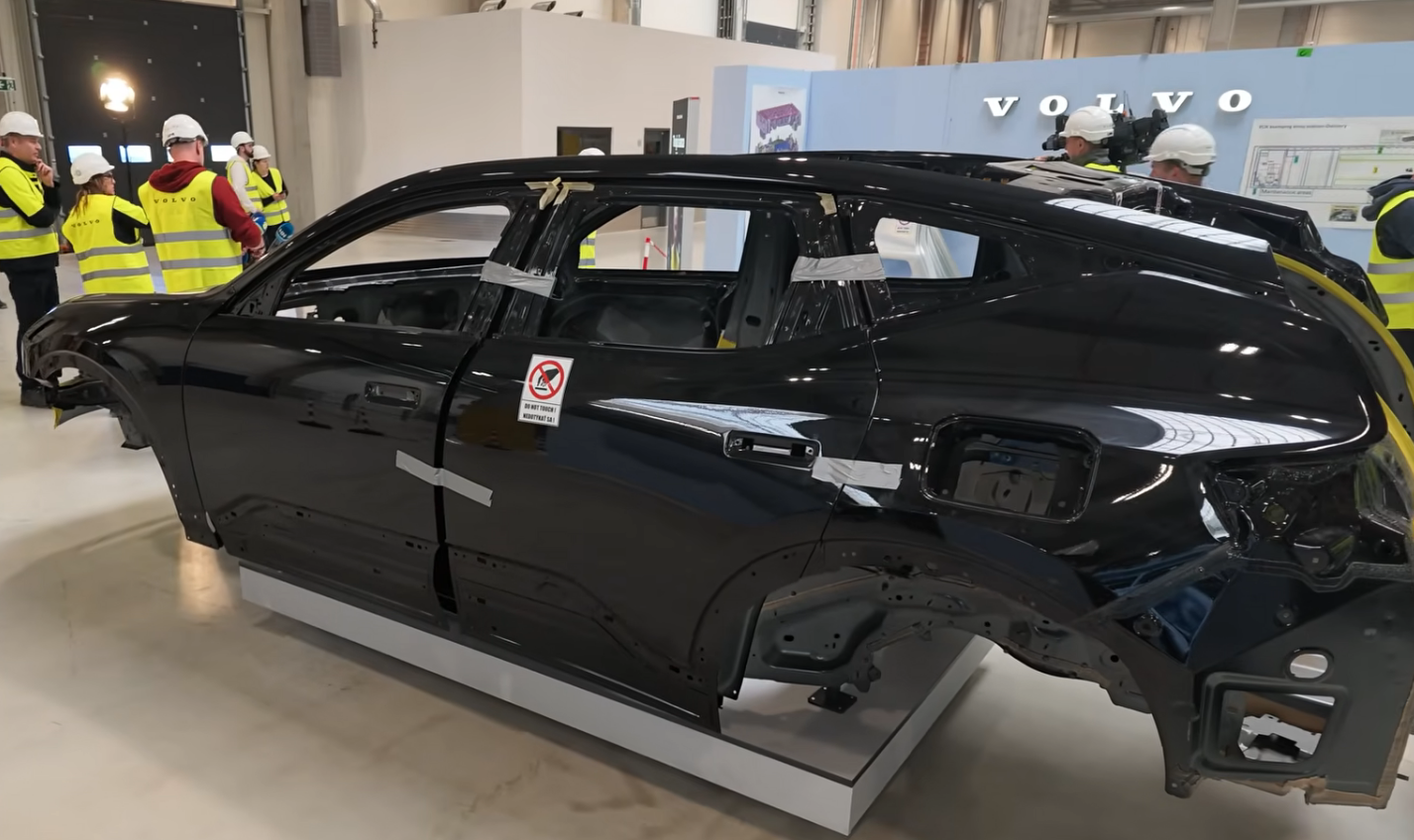
We haven’t seen the EX50’s design yet, but we have a clear sense of its language from the EX60. Additionally, a video detailing the construction of the Košice plant and its pilot production lines showed some neat details. These include several EX50 components, including the mega-cast lower rear end. It also showed a swoopy car shell that may be the EX50 or its cousin, the upcoming Polestar 7. Expect the Volvo to feature a more traditional compact SUV shape with an upright profile.
Inside, expect the EX60’s design language to carry over, likely with some small tweaks. Details like the large 15-inch curved touchscreen, the 10-inch digital cluster, and central glovebox should find their way to the EX50. The same goes for the center console design. Meanwhile, Volvo may ditch the power rear seatback recline for a manual one. Features like the hands-free power liftgate and heated and ventilated front seats will most likely remain.

2028 Volvo EX50: Faster, Snappier Tech
Modern cars, especially EVs, no longer adhere to the trickle-down effect. That’s the case with the Volvo EX50. According to Swedish automotive site CarUp, this entry-level small luxury SUV packs plenty of computing power. It features the NVIDIA Drive Thor chip. This operating system is four times quicker and seven times more efficient than the existing Orin chip on the EX60, EX90, and Polestar 3.
Furthermore, the HuginCore core computing and software stack complements this new chip. This gives Volvo’s latest EVs like the EX60 and the upcoming EX50 the necessary component to make them true software-defined vehicles. Together with the brand’s latest driver assistance features and Google UI, the EX50 brings the right kind of components. Will it be stable at launch? Or will it suffer from a ton of bugs like the EX90 and Polestar 3? We hope it’s the former. The EX60 seems to prove that Volvo’s software has made significant strides in stability and speed.
Finally, Volvo democratizes driver assistance technologies across its lineup. From the least expensive model to the flagship EX90, every Volvo uses the same suite. The EX50 should arrive with the latest iteration. That includes Pilot Assist and functions like automatic lane changing.
Effortless Performance, Scandinavian Style
Volvo EVs possess incredible power, especially in dual-motor AWD guise. The EX50 is no different. Beyond the software, CarUp’s findings on Volvo prototypes revealed juicy details regarding the EX50’s powertrain. An 87 kWh battery and a dual-motor AWD setup with a reported 476 hp. Sound familiar? That’s the same figure as the pre-facelift Polestar 2 with the Performance Pack or Performance Software Upgrade. However, the EX50 uses new, more efficient Volvo-developed electric motors.
What about the driving range? Most likely over 300 miles per charge with the smallest wheel option. CarUp also found one prototype with 235/55R20 tires. That may likely be the smallest option, with wider tires available on variants equipped with 21- or 22-inch wheels. The EX50 is the second vehicle underpinned by the SPA3 architecture following the EX60. It also has an 800V electrical architecture for super-quick DC charging when using a compatible charger.
On the suspension front, expect everything from the EX60 to carry over into the smaller EX50. That means standard adaptive dampers on the more powerful dual-motor models. Furthermore, the tuning may differ from the EX60. Luis Rezende, president of Volvo Cars America, told InsideEVs that the EX30’s replacement will be fun to drive. He also described the vehicle as larger and more spacious, totally giving away that he’s referring to the EX50.
Priced at the Heart of the Segment
With the SPA3 platform and all of the advancements that came with it, Volvo managed to undercut its competitors with the EX60. Expect this to continue with the EX50, which is expected to start in the high $40,000 range. A source familiar with the matter confirmed this to Automotive News. That effectively puts the EX50 in the same price range as the Genesis GV60 and Lexus RZ. At the same time, it undercuts several compact luxury SUVs regardless of powertrains. These include the Audi Q3, Mercedes-Benz GLA and GLB, BMW X1, Lexus NX, and more.
Combine the crazy quick DC charging speeds with over 300 miles of driving range, and you have a viable formula for the ideal small luxury SUV. Together with a compelling projected starting price, the EX50 has the potential to change the game. Expect the world debut to take place soon, likely in December or January, since production starts in March 2027. U.S. sales should follow early next year, with Europe taking priority. The 2028 Volvo EX50 should land in the U.S. before the end of 2027.
When it arrives in North America, the EX50 will likely arrive in Plus and Ultra trims only, as well as P6 RWD and P8 AWD flavors. Expect other markets to offer smaller battery options. On the other hand, North American-spec models will most likely offer only the 87-kWh pack. In terms of power output, the P6 RWD should have around 369 hp and 354 lb-ft of torque. Meanwhile, expect the P8 AWD to make 476 hp and nearly 500 lb-ft.