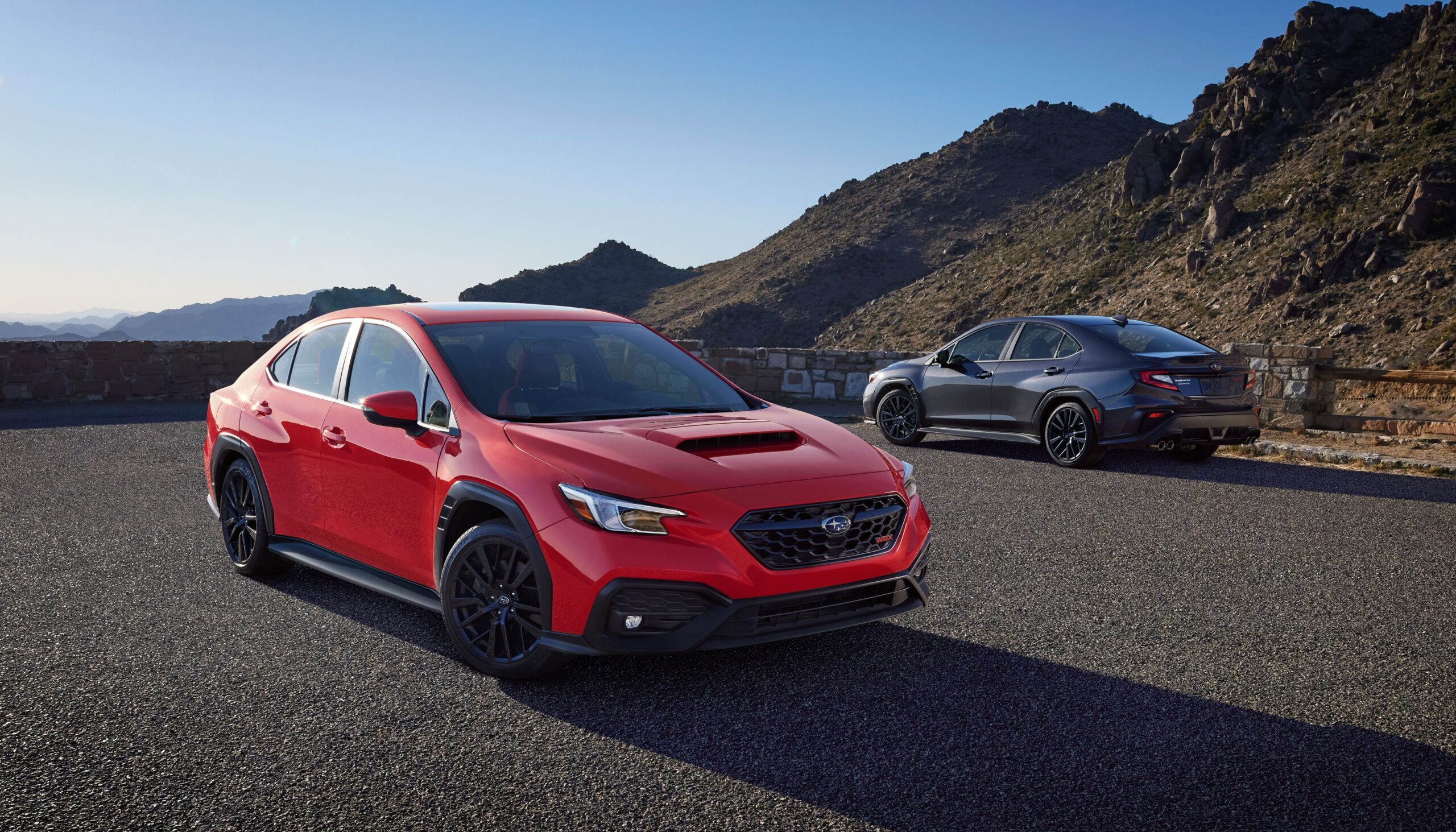
After a price increase and the discontinuation of the base model last year, Subaru has reversed course with the 2026 WRX. The new model year returns the base model and a lower price tag for the other four trims. Starting at $33,690, the base model features 18-inch wheels, dual-zone climate control, an 11.6-inch touchscreen, wireless Apple CarPlay and Android Auto compatibility, and LED headlights. Every 2026 WRX also comes standard with the EyeSight suite of driver assistance features. Upgrading to the Premium trim adds heated front seats, LED fog lights, and rear USB ports for $35,190, which is $3,755 less than last year’s equivalent model. An optional package adds a moonroof and an 11-speaker Harman Kardon premium audio system for $1,865 extra on the WRX Premium.
The 2026 Subaru WRX adds even more creature comforts. These include the two features that are part of the Premium trim’s optional package, a 10-way power driver’s seat, and a blind spot monitor with rear cross-traffic alert. It also features Ultrasuede and leather-trimmed seats with red bolsters and WRX headrest logos. With the six-speed manual, this trim checks in at $40,190. Adding the Subaru Performance Transmission costs $1,000 more. Versus last year, the manual model costs $3,155 less, while the SPT is $3,685 cheaper.
2026 Subaru WRX: Two Unique Range-Topping Models
At the top of the 2026 WRX lineup are the GT and tS models. Equipped exclusively with the SPT, the WRX GT builds on the Limited trim with a 12.3-inch digital cluster and Ultrasuede Recaro front seats with red bolsters. It also includes standard Electronic Adjustable Ride Control.
Meanwhile, the WRX tS comes exclusively with the manual transmission. It includes STI-tuned electronically adjustable dampers with Comfort, Normal, and Sport models. Additionally, the tS includes adjustments for the power steering, throttle response, and EyeSight suite. Plus, it has an Individual drive mode that allows drivers to save their custom settings. Every WRX tS comes with 19-inch alloy wheels wrapped in 245/35R19 Bridgestone Potenza S007 performance tires. For added stopping power, the tS also includes Brembo brakes with six-piston front and two-piston rear calipers in gold. It also has larger pads and rotors.
Inside, the WRX tS features the same Recaro front sport seats as the GT, but trades in the red for blue bolsters. The blue contrast stitching can be found on the seat bolsters, door panels, and shifter trim, and WRX tS headrest embroidery. Both the GT and tS cost $46,190 or $2,710 less than last year.
For those wanting something unique, the WRX Series.Yellow has your name all over it. Based on the tS and priced at $47,190, this includes yellow accents throughout the interior. It also comes in the exclusive Sunrise Yellow exterior, matte-black 19-inch wheels, and black exterior badges.
Still Steeply Priced?
Despite the price drop, the 2026 WRX still feels a bit steep. It remains in the same price bracket as the Toyota GR Corolla, Honda Civic Type R, and Volkswagen Golf R. Additionally, the Hyundai Elantra N costs similar money to the mid-level Premium grade, but possesses significantly higher performance capabilities. Moreover, the Golf GTI offers similar performance for similar money in the low end, or less in the top end, all while including more features wrapped in a practical hatchback body style. So yes, the WRX is cheaper now, but it’s still not at the price point that it needs to be at.
Keep in mind that, against the four vehicles mentioned above, the WRX has the second-lowest output. Its 2.4-liter boxer turbo-four has 271 hp and 258 lb-ft of torque. Only the Golf GTI comes in lower at 241 hp, bu it counters with more torque at 273 lb-ft. Yes, it comes standard with Subaru’s legendary Symmetrical AWD, but that may not be enough to justify the price tag. Additionally, only the SPT models get the variable torque distribution configuration, which has a rear-biased power distribution. Manual models include a simpler version with a center differential that splits power 50/50 front to rear at all times.
Source: Subaru