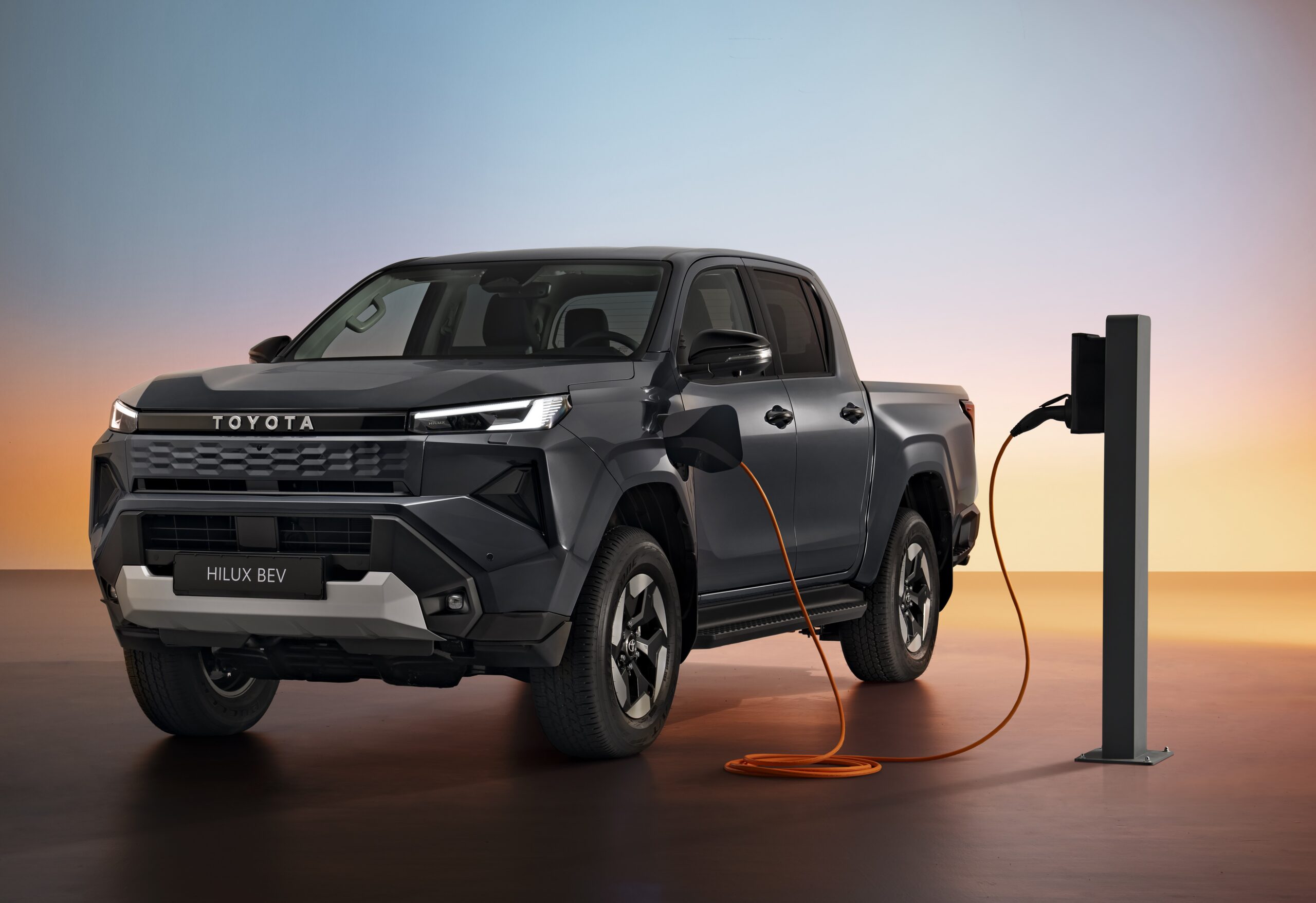
The iconic Toyota Hilux arrives for its ninth generation, and it has plenty of surprises. The iconic truck brings with it a whole range of powertrain options, including a battery-electric one, a first for this nameplate. Launching in Europe exclusively as a crew cab, it features a distinct new look featuring split headlights and a body-colored grille. In the EV variant, the latter is replaced by a pattern resembling a grille. That comes paired with unique aerodynamic wheels. In the rear, the new Hilux features reshaped taillights, complementing its boxier profile. Gas-powered models also have available sports bars.
Inside the ninth-generation Toyota Hilux, it’s all business. The truck features a 12.3-inch touchscreen and a 12.3-inch digital gauge cluster. Controls are grouped for easy access. Meanwhile, generous storage spots include an upper glove box and two cubbies on the center console. It even has another small bin to the left of the steering wheel! The Hilux also gains access to the MyToyota app that provides certain connected services and telematics functions for fleet managers.
Additional upgrades for the ninth-generation Hilux include electric power steering for Western European markets, a first for this model. Toyota says the system helps ease maneuverability and minimizes kick-back when driving on uneven pavement. Furthermore, the truck receives upgraded driver assistance features. It now includes Proactive Driving Assist, Low Speed Acceleration Suppression, and the Emergency Driving Stop System as part of its Toyota Safety Sense suite. The Hilux also supports over-the-air software updates for certain functions.

Toyota Hilux: All-Electric Truck Arrives
An expansive powertrain lineup returns on the ninth-generation Hilux. The biggest news? A battery-electric setup that Toyota says retains the truck’s off-road capability and reputation for quality, durability, and reliability. The truck retains its body-on-frame architecture and includes specific changes to protect the battery from damage, especially from water. In fact, the EV’s wading depth is equal to the internal combustion model. Moreover, the Hilux EV includes a Multi-Terrain Select system that uses brake and torque control to simulate the equivalent of driving in 4Lo mode in an internal combustion truck.
Power comes from a 59.2-kWh battery pack and two electric motors. The front motor produces 151 lb-ft of torque (205 nm), while the rear unit generates 198 lb-ft (268.6 nm), resulting in a rear-biased power distribution. Toyota Europe didn’t disclose power figures, but its Southeast Asia counterpart noted 144 kW or around 193 hp. In terms of payload, the Hilux EV has a maximum capacity of 715 kg (1,576 lbs). Meanwhile, payload capacity maxes out at 1,600 kg or just over 3,500 lbs. Finally, it has a driving range of 240 km or 149 miles on the WLTP cycle. However, Toyota didn’t disclose whether this number is for an empty truck or when hauling and towing a payload.
Familiar Powertrains Return
Looking for a conventional internal combustion model? The new Hilux continues to offer a 2.8-liter turbo diesel engine or a 2.7-liter gas engine in Eastern Europe. Meanwhile, other European markets have an available mild hybrid setup based on the 2.8-liter turbo diesel engine. It features a 48V lithium-ion battery, an electric motor, and a DC-DC converter. On the outgoing truck, this setup made 204 hp and 368 lb-ft of torque. This powertrain also has the highest tow rating at 3,500 kg or 7,716 lbs.
For off-roading, the mild hybrid Hilux retains the same 700 mm wading depth as its internal combustion siblings. It also has available off-road performance features like Multi-Terrain Select and the Multi-Terrain Monitor. Toyota also offers its surround view camera system called Panoramic View Monitor for street-focused models.
Toyota Hilux FCV: Coming Soon
The ninth-generation Toyota Hilux arrives for the European market in December 2025, starting with the battery-electric model. Mild hybrid models follow in the spring of 2026, followed by a fuel cell variant in 2028. With the introduction of the all-electric Hilux, we now know that Toyota’s TNGA-F architecture can accommodate a wide range of powertrains, including EVs. For North America, we’ve only seen gas and hybrids. We wouldn’t be surprised if we got an EV and a fuel cell vehicle on that platform, especially after seeing this and the Tacoma concept that debuted at the 2025 SEMA Show.
Source: Toyota


One thought on “New Toyota Hilux is Now Available as an EV!”
Comments are closed.