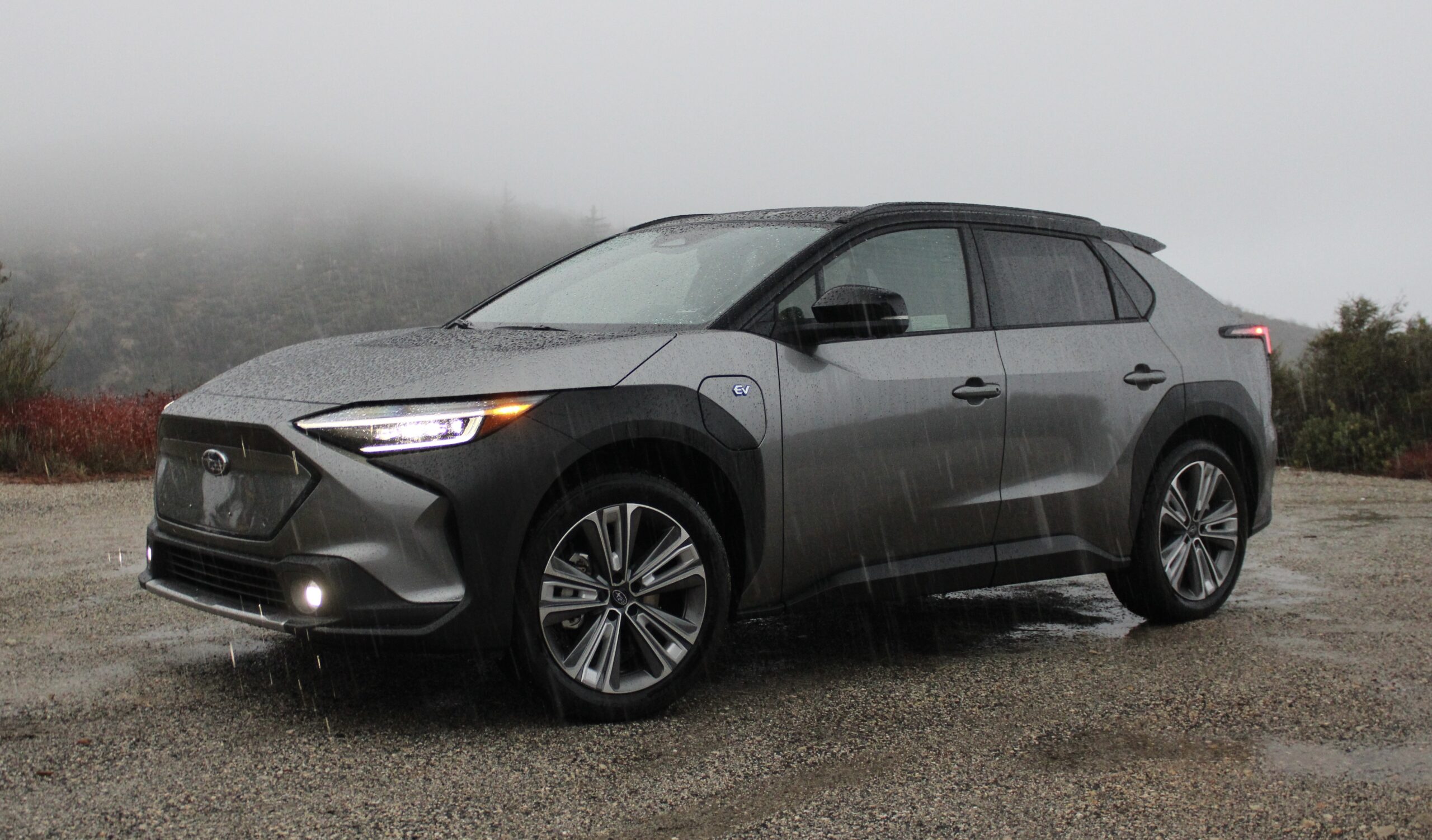
Among Toyota vehicles, the bZ4X (now the bZ) was among the first to feature Toyota Safety Sense 3.0 (TSS 3.0). What does this have to do with a Subaru? The 2023 Solterra is essentially the car’s twin, and Subaru equipped it with technologies that the Toyota version lacked at launch. One such feature is Proactive Driving Assist, an assistance feature now found on virtually every Toyota with TSS 3.0. We recently discovered this by accident on our 2023 Solterra while reviewing the settings for the driver assistance technology, TSS 3.0, which is badged as EyeSight. As responsible car nerds, we turned it on to see how well it worked. After a few days of driving, we’ve got some opinions. Strong ones.
So, what exactly does Proactive Driving Assist do? It helps you brake, accelerate, and more via cameras and radar. This allows the system to help anticipate everything from pedestrians, oncoming turns, and slowing traffic. The 2023 Subaru Solterra was among the first to include it. However, the system doesn’t work that well. It’s great at predicting things, but its inputs feel a little too clunky. It’s abrupt with the braking inputs, resulting in the car acting clunky and unrefined. Meanwhile, the accelerator inputs come off as overzealous in some situations. How so? The car simply ramps up too much power. As a result, it gets way too close to the vehicle ahead, then brakes hard, adding to its unrefined feel.
On the bright side, the steering inputs seem more natural. The car gently eases you into turns on the highway and helps you stay in your lane. It also gives you additional assistance when you’re changing lanes or maneuvering through tight spaces, which is nice.

2023 Subaru Solterra: The Ugly Bit
We’re not fans of the Proactive Driving Assist feature. Although it has useful functions, like steering assistance, its other components feel way too intrusive and need more fine-tuning. They act like they’re trying to take over driving duties from you, which shouldn’t be the case. These aren’t autonomous cars after all. The fact that Proactive Driving Assist deactivates when you turn on adaptive cruise control proves that this system was tuned to help you out. It needs to act that way instead of acting like an overprotective parent.
Perhaps the biggest reason not to turn on Proactive Driving Assist in a battery-electric vehicle like the Solterra is the way it slows the car down. Instead of using regenerative braking to maximize efficiency, it simply clamps on the mechanical brakes. That’s great in a gas-only car, but not in an EV, hybrid, plug-in hybrid, or fuel cell vehicle.
Subaru and Toyota need to recalibrate this to help optimize efficiency in electrified vehicles. To do that, it needs to take advantage of that electric motor to recapture energy instead of letting it go to waste like it does now. Have the system exploit the Solterra’s electrified nature to get it to operate more effectively. Allow Proactive Driving Assist to use every tool available to perform its intended function in a manner befitting electrified vehicles.
As it stands right now, the way Proactive Driving Assist operates doesn’t bring much value in the real world. Other than the steering assistance portion, everything else feels primitive, especially its use of mechanical brakes to slow down an EV. For that reason, we’ve turned the system off, and it’s staying that way until our lease period ends 10 months from now.